Business field 03
Electronics and embedded development
From requirement to series handover: schematic, layout, firmware and test from one source. Our platform of choice is Infineon's XMC family.
Complete circuit and embedded development
We take on the whole chain: requirements, schematic, layout, samples, firmware, verification and handover to series production.
Development runs in clearly separated steps, each with a defined deliverable. It starts with clarifying requirements, interfaces and constraints: supply concept, ambient temperature, EMC environment, quantities and expected service life. From that come schematic and layout, then sampled prototypes with a measurement report, then the firmware.
Why XMC: with XMC1000 (Cortex-M0) and XMC4000 (Cortex-M4F) the family spans a wide performance range under one continuous toolchain. Three properties matter most for our applications — the integrated high-resolution analogue peripherals with a 12-bit VADC in several converter groups plus a delta-sigma demodulator, the CCU4 and CCU8 timer units for precise, deterministic control and accurately timed triggering of measurement acquisition, and the long-term availability of a European manufacturer.
That control and measurement share one time base is not a side effect but the reason for the platform choice: because the timers trigger the converter directly in hardware, every sample falls at a defined instant relative to the drive signal — with no jitter from software. That is precisely what makes a measurement reproducible in a system that is switching and regulating at the same time.
Platform
| Parameter | Value |
|---|---|
| Controller family | Infineon XMC1000 (Cortex-M0), XMC4000 (Cortex-M4F) |
| Analogue peripherals | 12-bit VADC with several converter groups, delta-sigma demodulator |
| Timers and PWM | CCU4 and CCU8 — deterministic control and hardware triggering of measurement acquisition |
| Communication | UART, I²C, SPI, CAN, USB, Ethernet (device-dependent) |
| Development environment | DAVE / ModusToolbox, GCC toolchain |
Deliverables
- Requirements and interface specification
- Schematic and layout including complete fabrication data
- Sampled prototypes with measurement report
- Firmware including bootloader, drivers and update concept
- Test and end-of-line software for production
- EMC preparation and support through testing
- Documentation, bill of materials and series handover
Customisable to your requirements
- Form factor, installation situation and connectors
- Supply concept: battery, power supply, PoE or wide-range input
- Interfaces: UART, I²C, SPI, CAN, USB, Ethernet
- Firmware scope and control strategy
- Update and bootloader concept
- Extent of conformity work (EMC, safety)
- Production depth: samples, small batch or series
Typical projects
- Measurement and control assemblies for sensors
- Heater drivers with temperature control
- Data loggers and interface converters
- Controllers for laboratory and small equipment
- Redesign and obsolescence replacement of existing assemblies
VADC measurement modules — full stack
High-accuracy multi-channel measurement modules built on the XMC VADC: analogue front end, firmware and host integration as one matched deliverable.
“Full stack” here means the entire measurement chain comes from one source and is matched throughout. There is no point at which a third-party component caps the achievable accuracy without our being able to change it.
The XMC VADC delivers 12 bits natively. We raise the effective resolution through oversampling and averaging in the converter sequencer, combined with a calibration whose offset, gain and linearity coefficients are stored in the module. Conversion runs under DMA and is timestamped, so channels stand in a defined temporal relationship to one another.
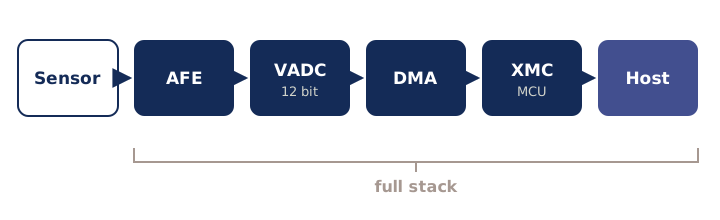
The five layers of the stack
- Analogue front end — input protection, scaling, filtering, reference
- VADC sequencer and DMA — triggered conversion, fixed channel order, timestamps
- Firmware — oversampling, digital filtering, calibration, limit monitoring
- Protocol — buffered transfer with timing reference, run-time configuration
- Host side — API for Python and C, recording and export formats
Customisable to your requirements
- Channel count and input range per channel
- Trade-off between sample rate and effective resolution
- Trigger and synchronisation concept, also across several modules
- Interface, protocol and data format
- Number and placement of calibration points
- Firmware extensions: control loops, limits, preprocessing on the module
- Enclosure, connectors and mounting form
- Host software: API, logger or integration into your existing environment
Typical applications
- Multi-channel test-bench instrumentation
- Cell-voltage measurement in battery testing
- Sensor acquisition with high channel counts
- Synchronised acquisition across several modules
- Embedded instrumentation inside series products
Related fields
From requirement to series
-
Specification
We clarify the application, constraints and acceptance criteria: temperature range, power, measuring range, installation, quantities, service life.
-
Design and samples
Design, engineering and sampled prototypes — each with a measurement report, so deviation from spec is documented rather than asserted.
-
Verification
Functional and endurance testing, thermal characterisation, EMC preparation and support through testing up to release.
-
Series
Manufacture of the components we developed, electrical end-of-line test, documentation, batch traceability and long-term availability.
Enquire about this field
Temperature range, power, measuring range, installation, quantity — with those we can answer concretely rather than generically.
Send an enquiry