Business field 02
Custom sensing and measurement
Two focus areas: thermal flow measurement for air, and high-accuracy acquisition of electrical and thermal quantities. We develop both up to the calibrated assembly with a measurement report.
Flow sensors for airflow measurement
Thermal flow measurement: a heated element gives up heat to the passing medium — the heat carried away is a measure of mass flow.
The measuring channel holds a heating element and two temperature sensors, one upstream and one downstream. With no flow the temperature profile is symmetric; with flow it shifts, and the temperature difference between the two sensors becomes the measurement signal. The sign of that difference also gives the flow direction.
The method measures mass flow directly rather than volume. Density changes caused by pressure and temperature therefore do not enter as measurement error — a substantial difference from purely volumetric methods.
Here the heating structure and the measurement electronics are the same assembly, so our two core competences meet in one component: we tailor the characteristic curve, channel geometry and calibration to your medium and measuring range.
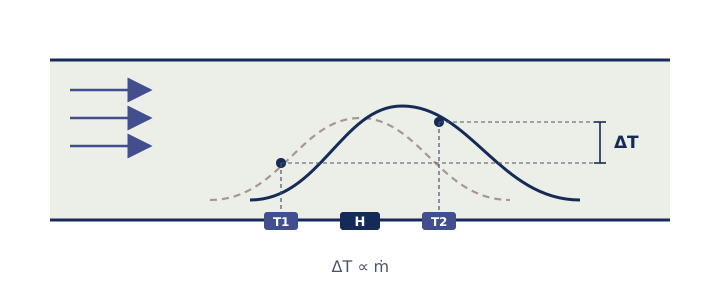
Measuring principle and configuration
| Parameter | Value |
|---|---|
| Measured quantity | Mass flow, convertible to standard volumetric flow |
| Medium | Air; other gases after calibration |
| Interface | Analogue (0–10 V / 4–20 mA), I²C, UART or CAN |
Customisable to your requirements
- Measuring range and characteristic curve tailored to your application
- Channel geometry, port threads and flow adapters
- Calibration for your medium and installation geometry
- Linearisation and temperature compensation already inside the sensor
- Interface and protocol to match your system environment
- Bidirectional measurement with flow-direction detection
- Factory calibration report per serial number
Typical applications
- Respiratory and ventilation equipment
- Ventilation and air conditioning, filter monitoring
- Fume hoods and safety cabinets
- Process air monitoring
- Leak and flow checking on test benches
High-accuracy measurement: voltage, temperature and more
Precision analogue work is mostly dimensioning and layout: low-noise signal conditioning, low-drift references, clean grounding and a calibration that stays inside the device.
Achievable accuracy is rarely decided at the converter alone. We therefore dimension the whole chain from sensor to digital value together: input protection and filtering, gain with defined offset and gain drift, a ratiometric or standalone reference, shielded and guarded layout regions for high-impedance nodes — and a calibration whose coefficients live in the device rather than in a spreadsheet at the user's end.
For temperature we support PT100 and PT1000 in 2-, 3- and 4-wire configurations, NTCs, and thermocouples with cold-junction compensation. Channels can be mixed and, where required, galvanically isolated individually or in groups.
Construction and options
| Parameter | Value |
|---|---|
| Supported temperature sensors | PT100/PT1000 (2-, 3-, 4-wire), NTC, thermocouples type K/J/T |
| Channel isolation | optionally galvanically isolated, per channel or per group |
Customisable to your requirements
- Channel count and mixed population: voltage, temperature, bridge sensors
- Measuring range set individually per channel
- Sensor type and wiring configuration per channel
- Isolation concept: per channel, per group or none
- Filtering and sample rate to suit bandwidth and noise requirements
- Calibration data stored in the device, field recalibration possible
- Interface, protocol and data format
- Enclosure, mounting form and connectors
Typical applications
- Test benches and automated testers
- Battery and cell testing: cell voltages and temperatures
- Climate and environmental test chambers
- Calibration and reference measurement stations
- Long-term data acquisition with drift requirements
Related fields
From requirement to series
-
Specification
We clarify the application, constraints and acceptance criteria: temperature range, power, measuring range, installation, quantities, service life.
-
Design and samples
Design, engineering and sampled prototypes — each with a measurement report, so deviation from spec is documented rather than asserted.
-
Verification
Functional and endurance testing, thermal characterisation, EMC preparation and support through testing up to release.
-
Series
Manufacture of the components we developed, electrical end-of-line test, documentation, batch traceability and long-term availability.
Enquire about this field
Temperature range, power, measuring range, installation, quantity — with those we can answer concretely rather than generically.
Send an enquiry